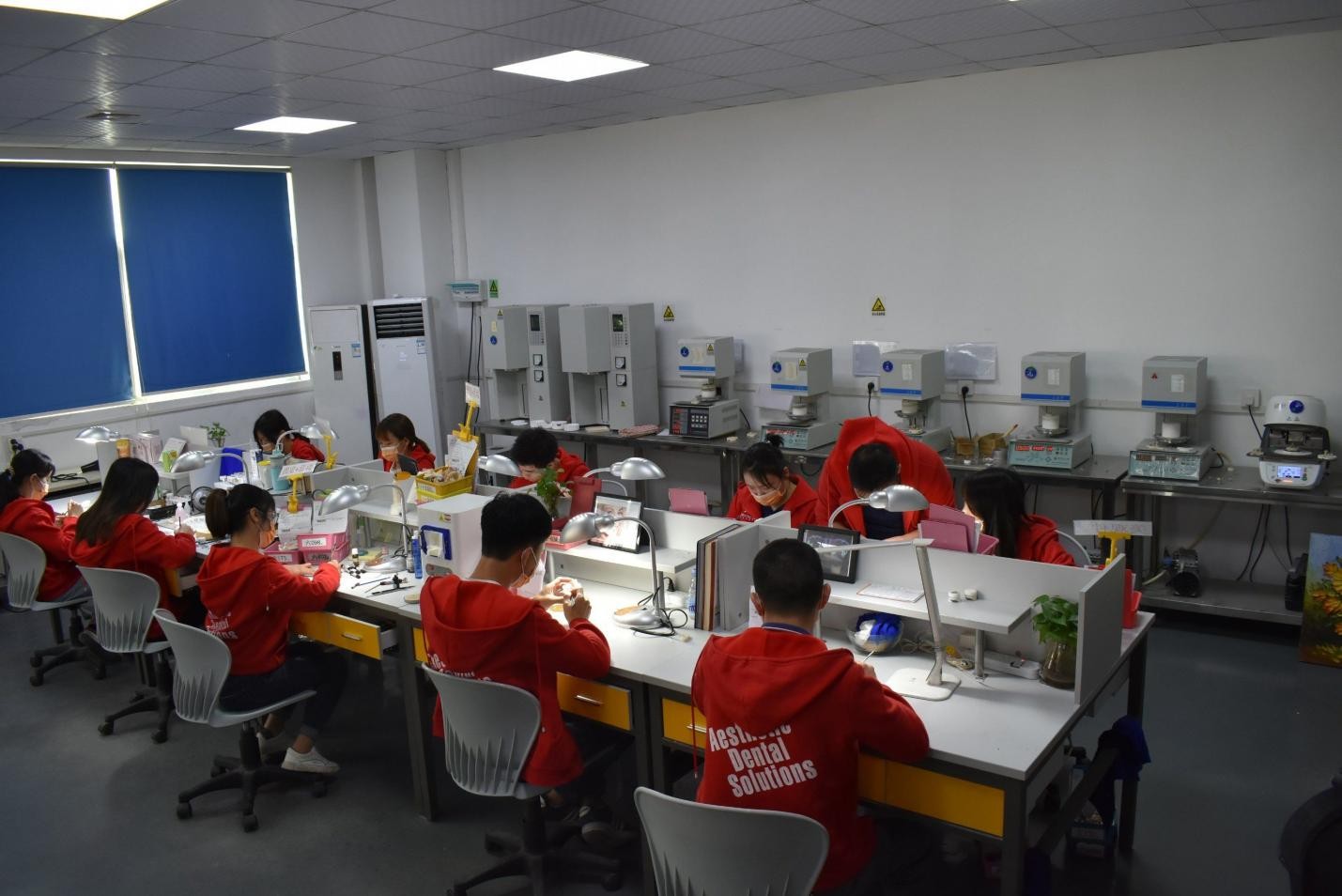
A practical guide to dental lab supplies, prosthesis types, and choosing the right dental laboratory equipment for your business model.
Opening a dental laboratory is a significant investment — in dental lab supplies, dental laboratory equipment, trained technicians, and time. Before ordering a single piece of kit, a clear business model must guide every equipment decision. This post outlines the major prosthesis categories, two distinct production pathways, and an honest look at return on investment for new lab owners.
Prostheses Produced in a Full-Service Dental Lab
A full-service laboratory handles a wide range of restorations across five main categories:
- Fixed prosthetics — crowns, bridges, veneers, inlays, and onlays (highest-fee category)
- Removable prosthetics — full acrylic complete dentures, cast metal partial dentures, flexible partials
- Implant prosthetics — titanium abutments, implant crowns, and implant-supported bars
- Orthodontic appliances — clear aligners, retainers, and thermoformed devices
- Occlusal & sleep appliances — night guards, splints, and surgical guides
Knowing which category your lab will focus on determines every subsequent dental lab material and equipment decision.
Pathway 1 — Manual Acrylic Complete Denture Lab
For a startup focused on hand-crafted acrylic complete dentures, capital costs stay low while demand remains steady, driven by an ageing population. This model demands fewer high-technology machines and more skilled bench work. Essential dental laboratory equipment includes:
| Equipment | Purpose |
| Vacuum mixer | Bubble-free dental stone pours |
| Vibrators ×2 | Model consolidation after pouring |
| Model trimmer | Trimming and shaping stone bases |
| Flask press kit | Acrylic processing and flasking |
| Air pressure curing unit | Dense, void-free acrylic denture base |
| Burnout oven | Wax elimination before casting |
| Lathe polisher | Final surface finishing and buffing |
| Sandblaster | Post-cast surface cleaning |
One compact wet/dry milling unit can be added later for PMMA temporary crowns, but a full CAD/CAM suite is unnecessary at launch. Keeping the dental lab supplies list lean means faster cash flow recovery — typically within 6 to 12 months of opening.
Pathway 2 — Digital Workflow for Fixed Prosthetics
When the business model targets higher-fee fixed restorations, a digital production line becomes essential. Glass ceramic veneers, pressed lithium disilicate crowns, zirconia bridges, and titanium implant abutments all require a CAD/CAM workflow built around precision dental lab supplies. The core digital chain includes:
- Intraoral or lab scanner — digital impression capture
- CAD/CAM design software — nesting, design, and milling path generation
- Multi-axis milling unit — wet milling for zirconia and glass ceramic; dry for wax and PMMA
- 5-axis wet mill with coolant — required for titanium implant abutments
- Sintering or crystallisation furnace — post-mill densification
Dental lab material costs for zirconia discs, lithium disilicate blocks, and titanium blanks represent the primary recurring expense in this pathway. However, the per-unit fee commanded — particularly for implant prosthetics — justifies the higher capital outlay over 18 to 36 months.
3D Printing in the Modern Dental Lab
SLA and MSLA resin printers have become essential dental laboratory equipment even in labs not focused on digital fixed work. Common 3D printing resin applications include:
- Model bases for crown and bridge cases
- Diagnostic wax-up and study models
- Surgical guides for implant placement
- Try-in bases and occlusal rims for complete dentures
- Thermoforming bases for clear aligner fabrication
Print costs per unit are a fraction of milled alternatives, and turnaround times drop dramatically. As resin printer output scales, post-processing becomes the production bottleneck — which brings us to one of the most significant new arrivals in dental lab supplies.
| New Arrival — Dual-Chamber Resin Post-Processor (Recover & Wash Unit) The Dual-Chamber Resin Post-Processor addresses the single largest inefficiency in 3D resin workflows: post-print cleaning. The left centrifugal chamber spins printed models at speed, mechanically removing uncured 3D printing resin and directing it into a dedicated recovery compartment — achieving over 95% resin reclaim for reuse. Models then transfer to the right cavitation chamber, where active alcohol flow and ultrasonic cavitation decontaminate all surfaces at low temperature in as little as three to five minutes. |
Advantages Over Traditional Ultrasonic Cleaners
Compared with a traditional single-tank ultrasonic cleaner, the Dual-Chamber Resin Post-Processor offers two clear advantages. First, the sealed centrifugal recovery stage eliminates open-bath resin contamination entirely: uncured resin never enters the alcohol, which means the solvent stays cleaner far longer, alcohol consumption drops by up to five times, and evaporation risk — a compliance and safety concern in many labs — is removed at the source. Second, the low-temperature cavitation wash in the right chamber delivers surface decontamination without the heat build-up that ultrasonic baths generate, protecting fine detail on precision models, surgical guides, and aligner thermoforming bases that would otherwise distort or delaminate under thermal stress.
ROI — Choosing the Right Model for Your Market
The most common mistake new lab owners make is purchasing full-service dental laboratory equipment before the case volume to support it exists. A phased approach — launch with manual acrylic complete denture capability, add a resin printer and Dual-Chamber Resin Post-Processor at month three, then commission a milling unit when fixed case referrals are confirmed — keeps overheads manageable and shortens the path to profitability.
| Business Model | Startup Cost | ROI Timeline | Notes |
| Manual Acrylic Dentures | Low | 6–12 months | Steady demand, fast cash flow |
| CAD/CAM Fixed Prosthetics | High | 18–36 months | High fee per unit |
| 3D Print Appliances | Medium | 12–18 months | Low material cost, high volume |
| Full Service Lab | Very High | 24–48 months | Maximum revenue ceiling |
Every major dental lab material and dental lab supplies decision should be tied to a confirmed or highly probable revenue stream, not aspirational capacity. Match your equipment investment to your confirmed market, start lean, and let a phased procurement plan anchor your business in real prosthesis demand from day one.
Sourcing quality dental laboratory equipment and materials is easier when everything is in one place. Dentsma offers an extensive selection of in-stock dental lab supplies — tools, equipment, and materials — ready to ship when you need them. Save Dentsma to your browser favourites and take advantage of bundle bargains to stock your lab smarter, not just cheaper.
| Key Takeaway Match your equipment investment to your confirmed market. Start lean, add digital capacity as case volume grows, and let a phased procurement plan — anchored to real prosthesis demand — protect your margins from day one. |